Illustration by Azra Hirji
By Kara Newman · Updated: August 18, 2026
Kara Newman is a spirits reviewer and author of several cocktail books, including Shake.Stir.Sip., Nightcap, and Cocktails with a Twist.
Increasingly, vodka makers are turning out distillates that play up nuanced flavor and let raw ingredients shine. Enter the rise of “varietal vodka.”
"If you’re going to burn your toast, it doesn’t matter if you start with a fancy loaf of bread,” says Eric Olson, director of distillery operations for Industrious Spirits Company (ISCO) in Providence, Rhode Island. ISCO makes Ostreida, an enticingly briny, divisive vodka distilled from local corn and whole oysters.
In other words: What’s the point of distilling quality ingredients into a vodka that tastes like nothing, by design?
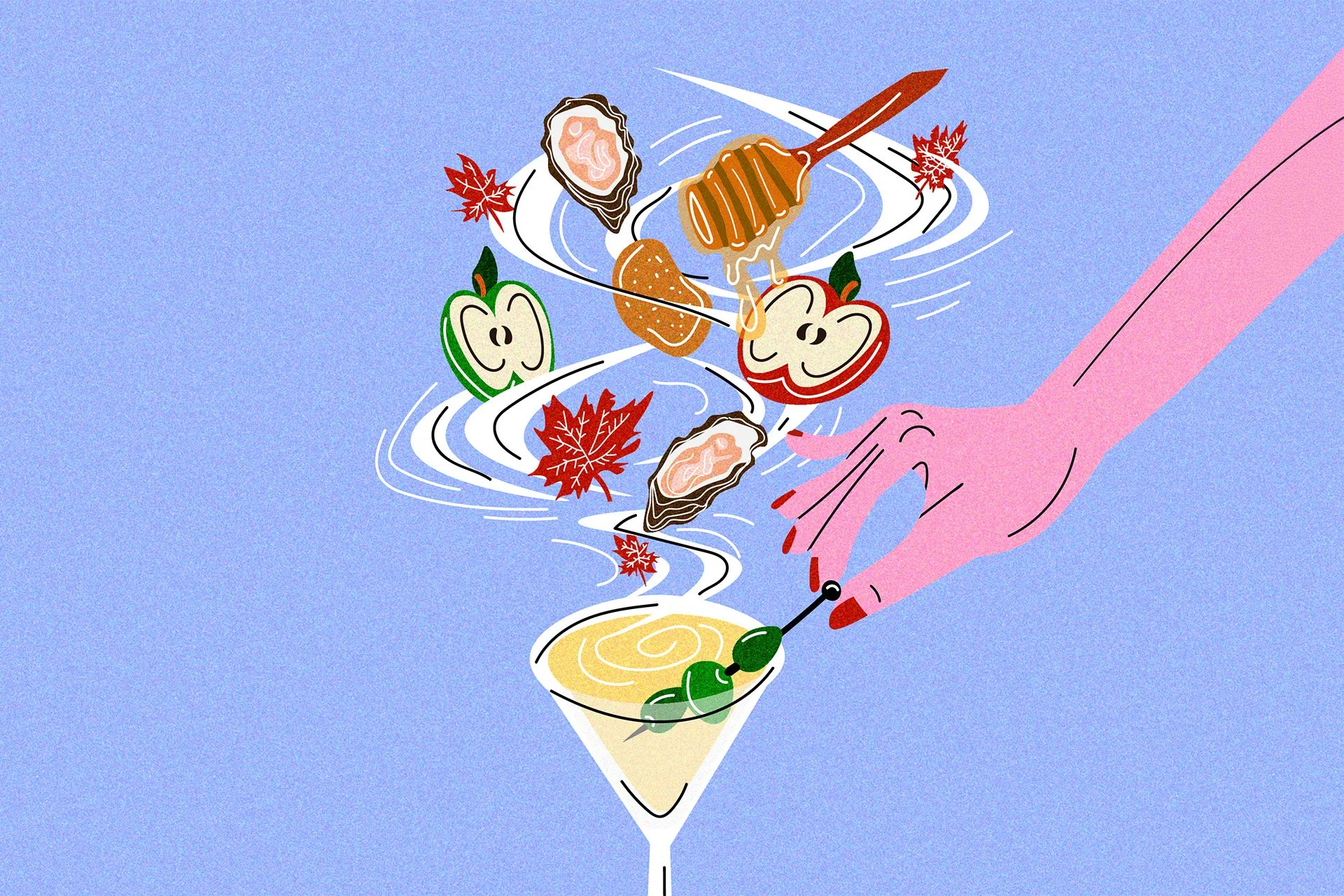
Increasingly, vodka makers are turning out distillates that play up nuanced flavor, letting raw ingredients shine, from robust, earthy potato vodkas to apple-based counterparts that tease fruit and apple blossom with each crisp sip. Some bottlings even incorporate bivalves to give the weirdest whiff of the sea to your martini glass.
How Vodka Earned Its Reputation
As with most spirits (and wine and beer), vodka was historically made to preserve agricultural abundance that might otherwise go to waste. Look around the world, says Veronika Karlova, the London-based chair of the World Vodka Awards, and vodka represents a diverse map of regional crops. “You look at Poland, you talk about barley or potatoes,” she says. “Russia, wheat or rye. Look at the U.S., the biggest producer of corn, so it makes sense to make vodka from corn. In France, they make a lot of vodka from grapes. New Zealand and Australia produce vodka from whey [a byproduct of cattle farms].”
Originally, most vodkas retained traces of those underlying ingredients in their flavor profiles, Karlova explains. Most were made using copper pot stills, which yield a rich, robust spirit. But the 19th-century invention of the tall, cylindrical column still enabled distillers to create lighter, more neutral spirits. Embraced by the “vodka belt” of the former USSR, Poland, and Baltic and Scandinavian countries, that style eventually became the norm.
Meanwhile, the rise of industrialization in the late 1800s severed the link between farms and spirit, and the decade-long Prohibition era erased collective knowledge about distillation. By the 1950s, highly processed foods were valued, including the concept of “purity” in vodka. It was distilled and filtered multiple times to ensure a clean, ultraneutral spirit that would come to shine in the martini culture of the 1980s and ’90s.
That would all change with the craft spirits boom of the 2000s.
The Rise of 'Varietal Vodka'
While much of the lore surrounding America’s craft spirits movement centers on whiskey and brandy makers who highlight local grains and fruit, vodka was there from the beginning, too. Unlike brown spirits, which demanded years in the barrel before reaching consumers, vodka could be bottled and sold almost immediately, making it an essential early product for many new craft distilleries.
In 2012, Woody Creek Distillers began making a “farm-to-flask” potato vodka with spuds grown outside of Aspen, Colorado. (Whiskey, and a partnership with William H. Macy, would follow much later.) No, it doesn’t taste quite like a roasted potato, but it has a distinct earthy, buttery quality, chased by cracked black pepper. Elsewhere, Vermont Spirits distills maple sap into a lightly sweet vodka with a distinct hint of maple, while Caledonia Spirits (also Vermont-based) makes Barr Hill Vodka from honey, for a viscous sip tinged with orange blossom and vanilla.
A key moment came in 2020, when the Alcohol and Tobacco Tax and Trade Bureau (TTB) officially updated the Standard of Identity for vodka, removing language defining vodka as “without distinctive character, aroma, taste, or color.” Freed from official constraints and public perception that it should be wholly neutral, vodka has slowly blossomed.
Over the past eight years, producers have developed so many expressive vodkas the World Vodka Awards created two new categories for entrants: “varietal vodka,” which spotlights the character of the underlying raw ingredient(s), and “botanical vodka,” meaning something is added to the vodka after distillation, such as an infusion. The latter is akin to gin minus the juniper and differs from flavored vodka, which may include sweeteners or synthetic flavors and can be bottled at a lower proof. Ostreida—the vodka distilled with oysters—would be considered a botanical vodka.
Building a Better Vodka
If wine can lean into terroir, why can’t vodka? That’s what producers like Dakota Blaze Rader, founder of Golden Eagle, want to know.
Golden Eagle is made with Dark Northern red wheat that’s grown in Montana. “The primary driver of flavor in our product is the environment,” Rader insists. “The climate that this particular wheat variety grows in and thrives in is extreme: hot days, cold nights, dry temperatures, direct sunlight in the morning … the environment drives deep root systems and really robust wheat flavor.” They’ve taken pains to preserve that flavor via longer-than-usual fermentation times and single distillation. The company is even reframing the spirit as “character vodka.”
At Kachka, a Portland, Oregon, restaurant specializing in Russian cuisine, vodka is served alongside caviar and zakuski (snacks), ranging from smoked fish to meat-filled Siberian pelmeni or cheese-filled vareniki. The backbar represents around 50 bottlings from around the world, including a beloved horseradish-infused vodka.
In 2025, Kachka opened a second location with a bar and distillery (Kachka Fabrika) to manufacture the horseradish vodka that had become its flagship. They also started distilling a Russian-style vodka (unflavored) after a 2022 federal ban on the import of Russian goods made the country’s vodka impossible to obtain in the U.S.
“We’re very proud to not have Russian products on our shelves,” says Israel Morales, Kachka’s co-owner and director of operations. “But the fact is, in 2022, it comprised about 70% of our backbar. When that went away overnight, we saw a hole in the market, as well as on our shelves.”
It also provided a crash course on the subtleties of vodka: Was it possible to build a Russian-style vodka using non-Russian ingredients?
“To really talk about vodka, especially Russian-style vodkas, is to really focus on two things,” Morales says. “The base ingredient, which is almost always exclusively grain, or winter wheat. And then, filtration.” Kachka’s version starts with Italian soft winter wheat, sourced from Canada, distilled in their Portland facility, proofed with local water, filtered through quartz for minerality and salinity, and finished with silver-impregnated Ukrainian birch charcoal for “creaminess and weight.”
Nuanced? Yes. Neutral? Not exactly.
The Road Ahead
While vodka distillers have taken the idea of character and turned the dial to 11, not all drinkers are ready for innovative vodkas.
Jon Kreidler, co-founder of Minneapolis distillery Tattersall, was a vocal proponent of the 2020 TTB language update. “There’s a big difference between vodkas, if you taste them,” he declared at the time. “To claim that vodka is flavorless and tasteless is just silly.”
Yet when he rolled out two versions of vodka made with Midwest corn—one emphasizing corn’s sweetness, the other more neutral—the latter won by a wide margin.
Providence’s ISCO also pulled back a particularly flavorful corn vodka (Olson remembers “sugar cookie, corn husk” tasting notes) that didn’t find an audience. But redistilled with the “merroir” of oyster shells, meat, a bit of sea kelp, and it’s a briny hit for dirty martinis and more. The lesson: People are leaning into brine and flavor—when it comes with a story.
5 Not-Exactly-Neutral Vodkas to Try
Rocket Vodka
Made from apples, it’s no surprise this California-made vodka offers nuanced fruit notes.
This article originally appeared in the October 2026 Rising Stars Issue of Wine Enthusiast magazine. Click here to subscribe today!
